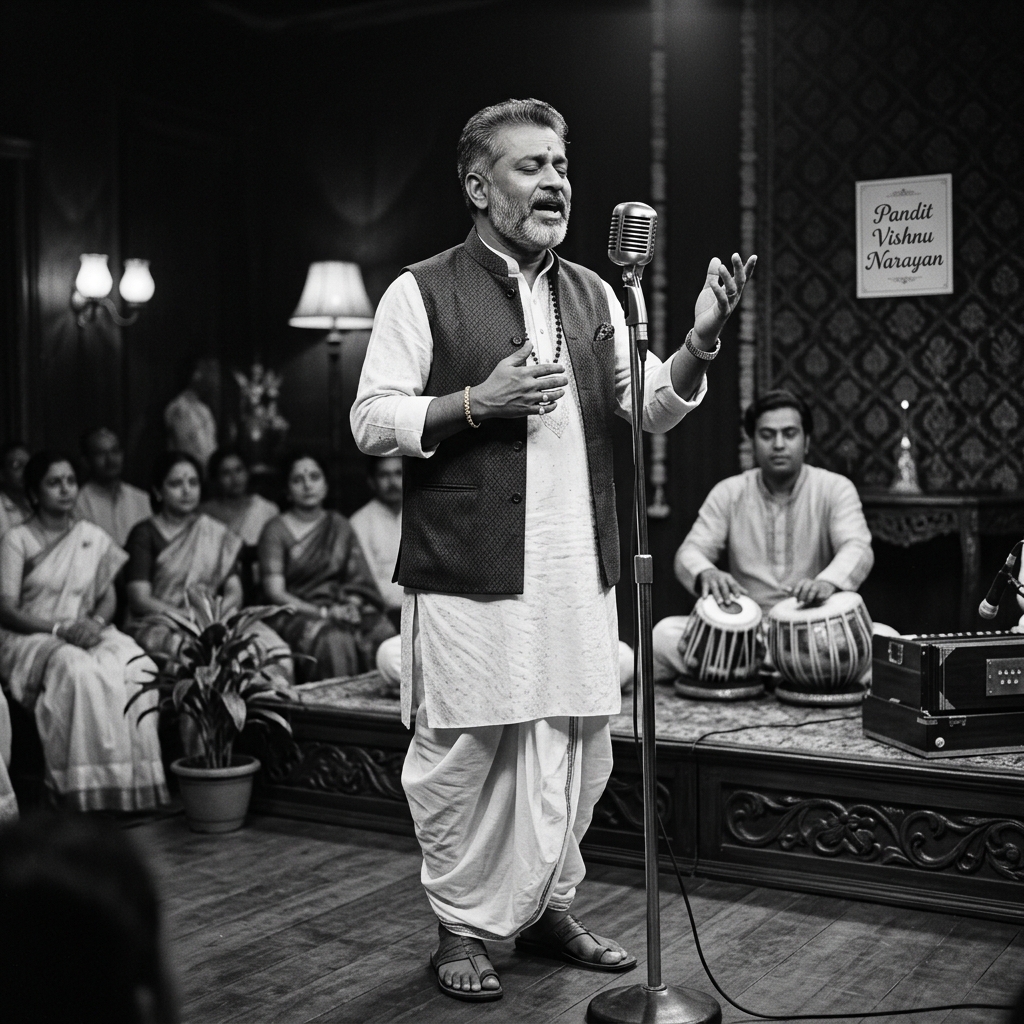
Hemanta Mukherjee (16 June 1920 – 26 September 1989), known professionally in Hindi cinema as Hemant Kumar, was a legendary Indian playback singer, music director, and film producer. Renowned for his deep, soothing baritone voice and his masterful interpretations of Rabindra Sangeet, he sang and composed in Bengali, Hindi, and several other regional languages.
Early Life and Musical Awakening
Hemanta was born in Varanasi but his family relocated to Calcutta (now Kolkata) in his early childhood. He grew up in Mitra Institution school in Bhawanipur, where he developed a lifelong friendship with the future legendary writer Subhash Mukhopadhyay.
Initially, Hemanta enrolled in Jadavpur University to pursue engineering, but he discontinued his studies to follow a full-time career in music. He recorded his first song for All India Radio in 1937, and by 1940, he had released his first commercial gramophone record, launching a career that would span more than five decades.
Musical Contributions & Collaboration
Hemanta Mukherjee’s contribution to Indian cinema is monumental:
- Collaboration with Salil Chowdhury: In the late 1940s, Hemanta collaborated with legendary composer Salil Chowdhury. Together, they revolutionized Bengali non-film music with path-breaking, orchestration-rich songs like Runner and Palkir Gaan (based on poems by Sukanta Bhattacharya and Satyendranath Dutta).
- Rabindra Sangeet Maestro: He was a pioneer in popularizing Rabindranath Tagore’s songs (Rabindra Sangeet) among the masses, presenting them with clean diction, rich acoustic arrangement, and emotional depth.
- Bollywood Success: Moving to Mumbai (then Bombay) in 1951, he composed the blockbusting scores for films like Anarkali (1953) and Nagin (1954), the latter winning him the prestigious Filmfare Award for Best Music Director.
Legacy and Honors
In 1989, Hemanta traveled to Dhaka, Bangladesh, to receive the Michael Madhusudan Award. Shortly after returning to Kolkata, he suffered a cardiac arrest and passed away on 26 September 1989. His voice remains a cultural staple in Bengali households, symbolizing the golden era of Bengali music and cinema.