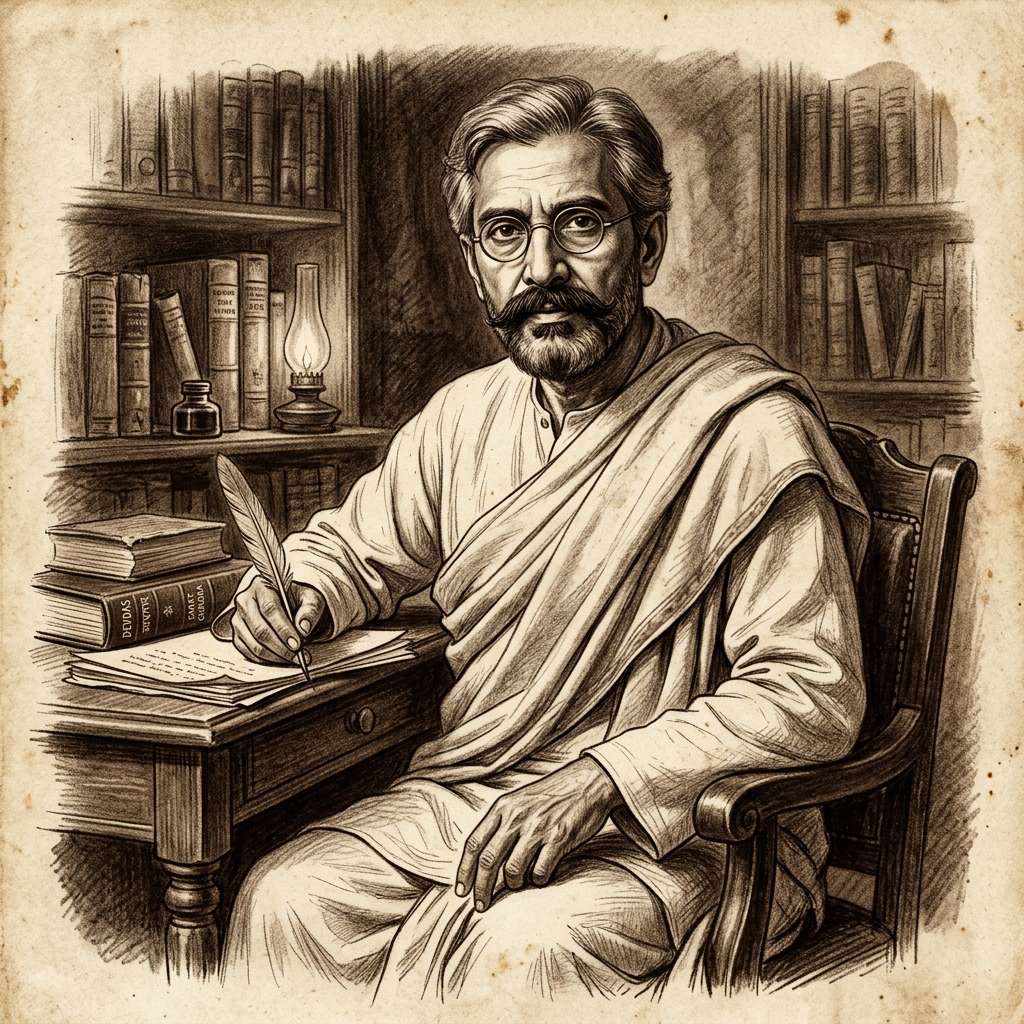
Sarat Chandra Chattopadhyay (alternatively spelt as Sarat Chandra Chatterjee) was an eminent Bengali novelist and short-story writer. He is arguably the most translated and widely read Indian novelist of all time. Writing during the period of the Bengali Renaissance, his stories captured the complex socio-economic realities of rural Bengal, the struggles of women against oppressive customs, and the emotional vulnerabilities of human relationships.
Early Life and Struggles
Sarat Chandra was born in Debanandapur, a small village in Hooghly, West Bengal. His childhood was marked by extreme poverty as his father, Motilal Chattopadhyay, was an idealist but irregular earner. Consequently, Sarat Chandra spent much of his childhood at his maternal uncle’s house in Bhagalpur, Bihar.
His education was interrupted due to financial crises. However, he inherited a love for literature from his father, who left behind many unfinished manuscripts. In 1903, Sarat Chandra moved to Rangoon (Burma) in search of employment, where he worked as a clerk in a government office. It was during his years in Burma that his literary talent began to flourish and gain recognition.
Literary Themes and Impact
Chattopadhyay’s writing is characterized by its simple Bengali prose, rich narrative structure, and deep psychological insights:
- Feminist Undercurrents: Unlike many of his contemporaries, Sarat Chandra portrayed women with strong agency, intellect, and moral courage (e.g., Rajlaxmi in Srikanta or Sabitri in Charitraheen).
- Social Criticism: He vehemently criticized the caste divisions, rigid religious orthodoxy, and patriarchal family systems of early 20th-century Bengal.
- Political Patriotism: His novel Pather Dabi (The Demand of the Road) was banned by the British colonial government because it detailed a revolutionary movement fighting for Indian independence.
Legendary Bibliography
A large portion of Sarat Chandra’s works have been adapted into award-winning films across multiple Indian languages, most notably Hindi and Bengali:
- Devdas (1917): The legendary tragedy detailing love, societal rejection, and self-destruction.
- Parineeta (1914): A sweet romance examining class differences and adolescent affection.
- Srikanta (1917–1933): A four-part semi-autobiographical masterpiece detailing the wanderings of a free-spirited protagonist.
- Chhoto Bou (1913) & Bindur Chhele (1914): Heartwarming stories about the joint family structure in Bengal.